Main Plant Station Activities

Antenna Status:
All antennas at the Main Plant station are presently off-line.
We are working to get some HF capability back as soon as possible.
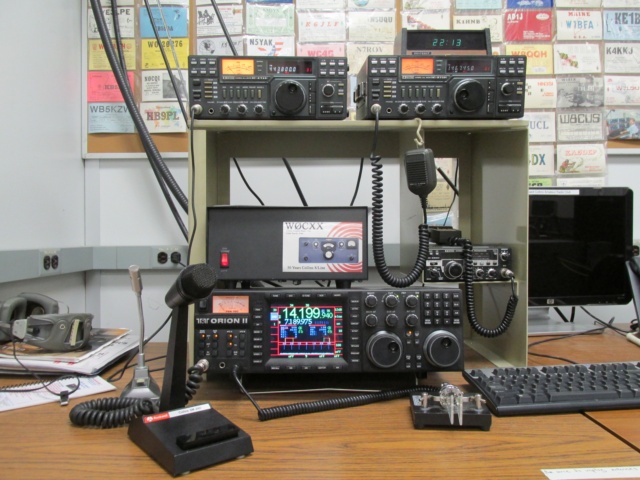
Status: The Flex 5000 is back in operation. Thanks to Al Groff (K0VM) for making this happen. The root cause of the problem was a cold solder joint on the I2C bus that handles PTT
Issue: New roof for butler buildings. New antennas.
Progress:
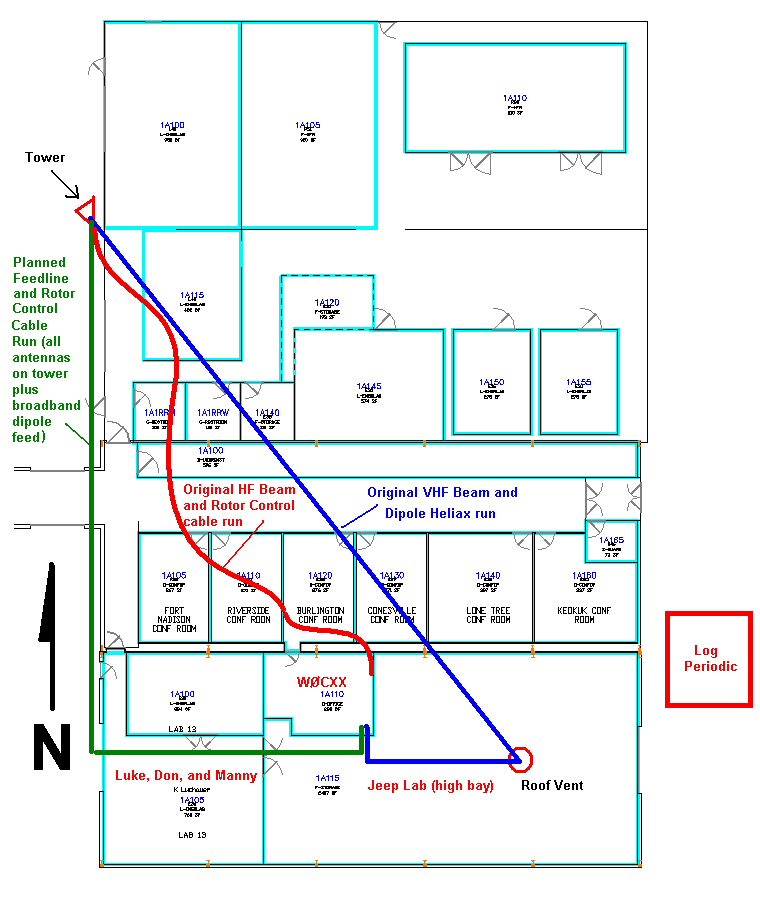
The cable raceway is (mostly) installed. It looks like they
still need to hang the very south end of it (see pictures below). In case it
isn't obvious, the raceway running horizontally up near the roofline is what is
new.
The bulkhead panel is being
fab'd (for access into the building for all feedlines and control cables for
antennas mounted on the west side of the Butler buildings). Facilities will
hold onto it and await the arrival of the Polyphasers and DB-25's so that they
can be installed in the panel before putting the panel into the outer wall of
Butler 150.
I have been told, but
did not see for myself, that the mount for the SteppIR vertical has been flashed
in. They forgot to put in the 3" pipe for feedline and element control cable
access for the vertical and the 75-meter dipole. They will be adding this soon.
The entry point for the SteppIR vertical and the 75-meter dipole will be
co-located with the SteppIR vertical mount (in the roof peak of Butler
149).
Need:
I would like some help in
ordering/building/whatever RG-8 coax and rotor control cables for the interior
of Butler 150. These will be the cable runs that are inside the building, and
go from the bulkhead panel to the shack. There will be a raceway installed that
goes from the west wall of Butler 150 to over the top of the shack. The catwalk
that is in the Jeep Lab is going to be extended so that we can easily access the
bulkhead panel/raceway. This needs to be done right after facilities installs
the panel because the first thing they're going to do after cutting a hole in
the outer wall of the building and bolting in the panel is to pack insulation
against the inside of the panel to prevent condensation on the panel. It will
be MUCH easier to install the interior cables if it is done BEFORE the
insulation is packed in.
Whoever
volunteers for this, here are the specifics:
Connector ends for coax need to be N-males on one end (to
connect to the Polyphasers) and <nothing> on the other end (to hang inside
the shack and eventually be connected to our patch panel inside the shack).
Connectors are TBD for the ends of the coax inside the shack.
Talk with Joe Spinks (AAØKW) for what has
been procured for the two DB-25's. If they are panel-mount, that means that
inside the building, it will most likely be solder cups. So, a means to
strain-relief the two control cables needs to be designed by the volunteer(s).
If it is a bulkhead connector (a DB-25 on the inside and a DB-25 on the
outside), then the gender of the inside connector needs to be determined in
order to fabricate the mating connector on the inside (including locking
mechanisms like thumb screws... assuming the bulkhead connector has the jacks
for it).
Inside the building, we are
going to populate (attach cables to) all polyphasers and all 50 pins of the two
DB-25's. This way, whenever we change or add antennas or rotor/element control
cables, all of the wiring will be done between the shack and the bulkhead
panel... we'll have no need to gain access to the secure Jeep Lab.
Labeling/marking of all internal cables (on
both ends, including labeling individual wires and listing which pin number of
which DB-25 they go to) is necessary. I have an idea for how to document this.
Whoever volunteers for the job, please see me. As always, I'm open to others'
ideas on how to do it.
That's
all for now. Again, I would like someone to volunteer to do the interior
cabling. This involves determining cable lengths needed. I will work with you
on all aspects of this to make sure we have a solid plan.
-- Mike, ACØPB
The Plan:


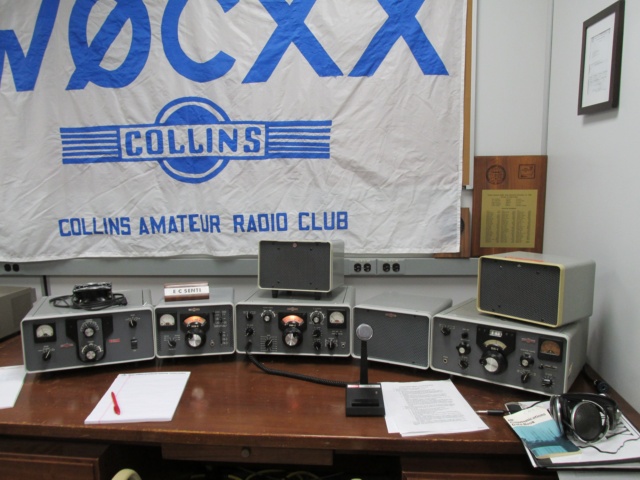
Issue: (Issue resolved) There is no RF output from the KWM-2 transceiver in phone, CW, tune, or key lock emission modes. The receiver appears to be working fine. The best guess at this time is that the problem lies somewhere in the Tx audio lineup.
Summary: As it turned out, there was
no_trouble_found. Since he had the xcvr on his bench already, Rod Blocksome
(K0DAS) gave the KWM-2 a checkup. The parameters adjusted/replaced/checked:
* Touched up the PA and driver neutralization adjustment
* Noticed AM tone modulation on Tune & CW
emission with low setting of Mic gain. Problem traced to
problems in audio oscillator and poor SSB carrier
suppression. Problem fixed by:
-
Replaced paper electrolytics with new
- Replaced 1N34A diodes in balanced modulator with 1N5711 (then could
adjust for very good carrier suppression)
* De-oxit all switch contacts
* Checked VFO cal spread: okay
NOTE: When the KWM-2 was set up in the shack, the Tx key would
oscillate at a slow rate (about 1 Hz). This would happen only when the
microphone was plugged in and the MIC gain turned on. Danny Rhoades (WB0LJK)
asked what the VOX gain was set to... Looking, we noticed that the VOX gain was
cranked all the way up. It was then turned it down to minimum; this alleviated
the problem. So, if anybody likes using VOX, be aware that currently the VOX
gain is turned down (knob is inside the top panel).
ANOTHER NOTE: The Turner microphone that is connected to the
KWM-2 requires that the PTT switch on the base of the microphone be used in
order to talk. Using the PTT foot pedal will put the KWM-2 into transmit mode,
but there will be no mic audio. This will be investigated as time permits, as
it would be desirable to use this microphone in conjuntion with the foot PTT
pedal.
Vintage Station
New KWM-2 Power Supply
Issue: A Collins
516F-2 DC power supply was purchased by the club at Dayton 2010. This supply is
to replace the Collins PM-2 lightweight supply that is presently powering the
KWM-2. The supply was purchased with a capacitor kit included (but not
installed).
Need: Nothing at this time.
Additional Information: Bob Klaus has recapped the supply. Bob and Mike Hynek will be reforming the capacitors in the supply.
Antenna Patch
Panel Replacement C Bulkheads (Done)
Issue: (Issue resolved). The bulkhead connectors used on the antenna patch panel are C connectors. The center conductor female pins on several of these connectors have broken “fingers”, resulting in a less-than-optimal connection. As such, these connectors need to be replaced. Operation of the shack can proceed, but with caution (check VSWR when using any of the antennas or the dummy load).
John DeJournett (KD0JXN) installed new bulkhead connectors on the patch panel. Thanks, John.
Need:
Additional
Information: